AI-Native SDLC: Trust Receipts for Agent-Generated Code
AI agents are changing how quickly we can produce code. They have not answered the harder question: how do we know that code can be trusted?
That is the missing layer in today’s AI-native SDLC.
A better model starts with a simple rule: every agent-generated change should carry a trust receipt—a traceable record of what we intended, what the agent changed, what was verified, what remains uncertain, and who approved the risk.
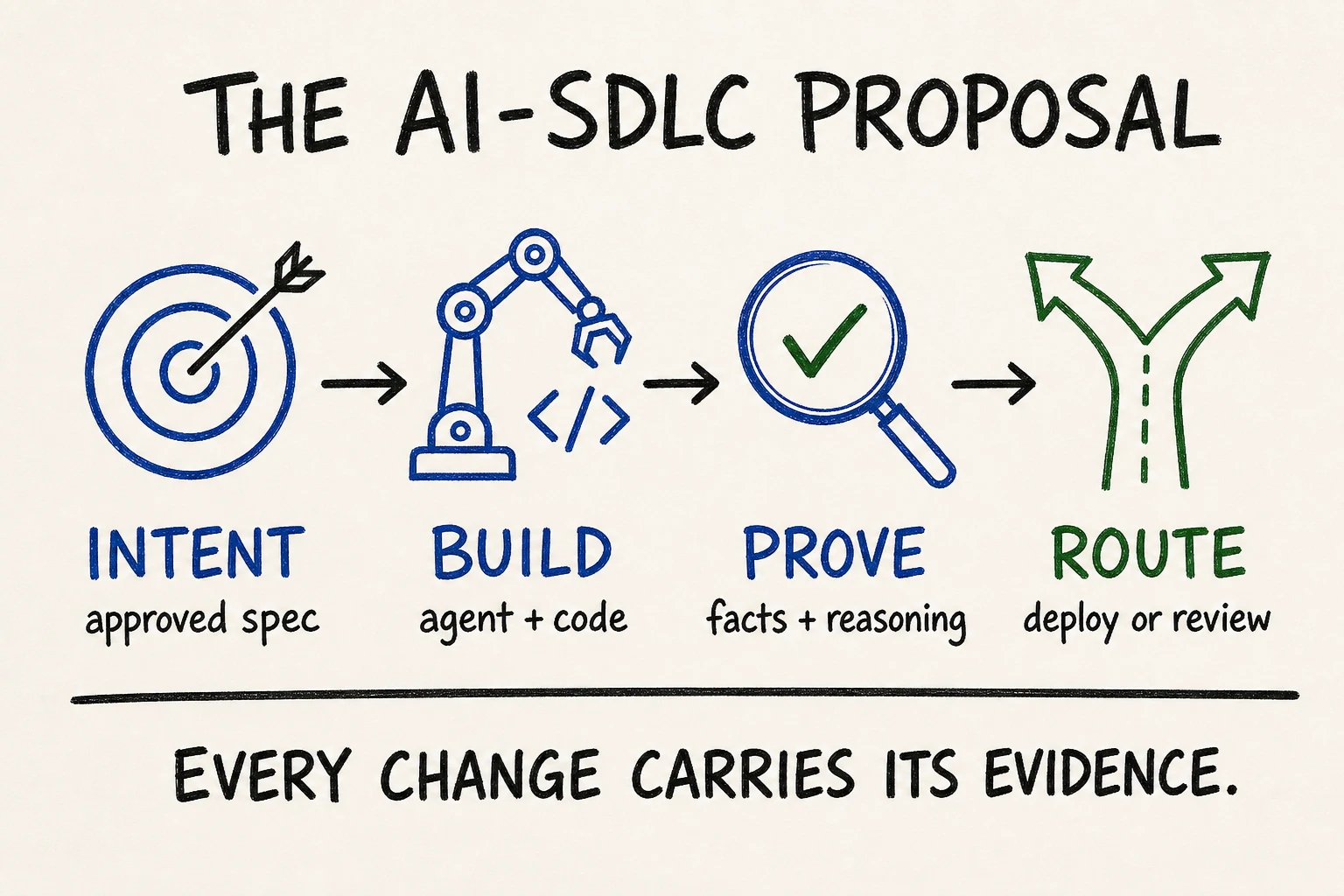
The model requires three changes: make intent readable, make verification independent, and make evidence portable. A risk policy can then read the receipt and decide whether a change merges, enters a canary, or waits for a person.
We accelerated code, not delivery
An AI agent can finish a feature while I make coffee. It can also open a pull request with 38 changed files, eleven new tests, and one unresolved question: does this change deserve to exist?
Traditional CI has two ways to answer that question.
Software handles what we can encode as rules: builds, tests, types, linters, and security scans. Humans handle meaning: whether the code matches the requirement, fits the architecture, and is worth the risk.
That worked at human production speed. Intent lived in a Jira paragraph, an old design document, or the memory of the engineer who handled the last incident. Because only people could reconstruct the context, people had to review every change for meaning.
AI increased code-generation capacity without increasing the supply of human attention.
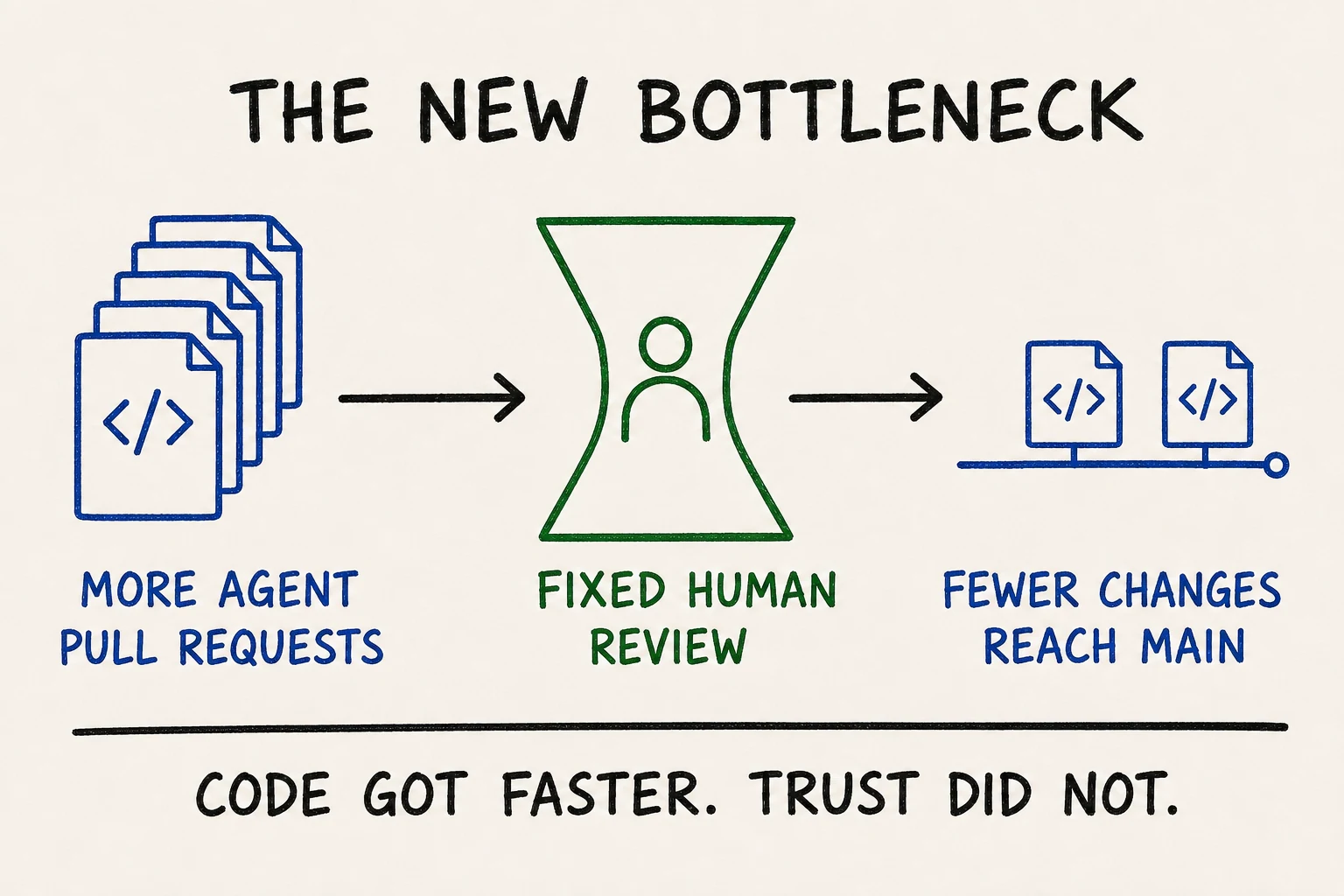
CircleCI analyzed more than 28 million workflows in 2026. For the median team, feature-branch throughput rose 15% while main-branch throughput fell 7%. Main-branch success dropped to 70.8%, and the typical recovery time reached 72 minutes.
More work appeared where AI helped create it. Less made it through the point where an organization had to trust it.
A better model: a trust receipt for every change
Most pipelines return a traffic light: green or red.
Green means the checks that happened to run did not fail. It does not explain why those checks were selected, which requirements they cover, what was never checked, or how much uncertainty remains.
In this model, an AI-native pipeline preserves that evidence in an itemized trust receipt.
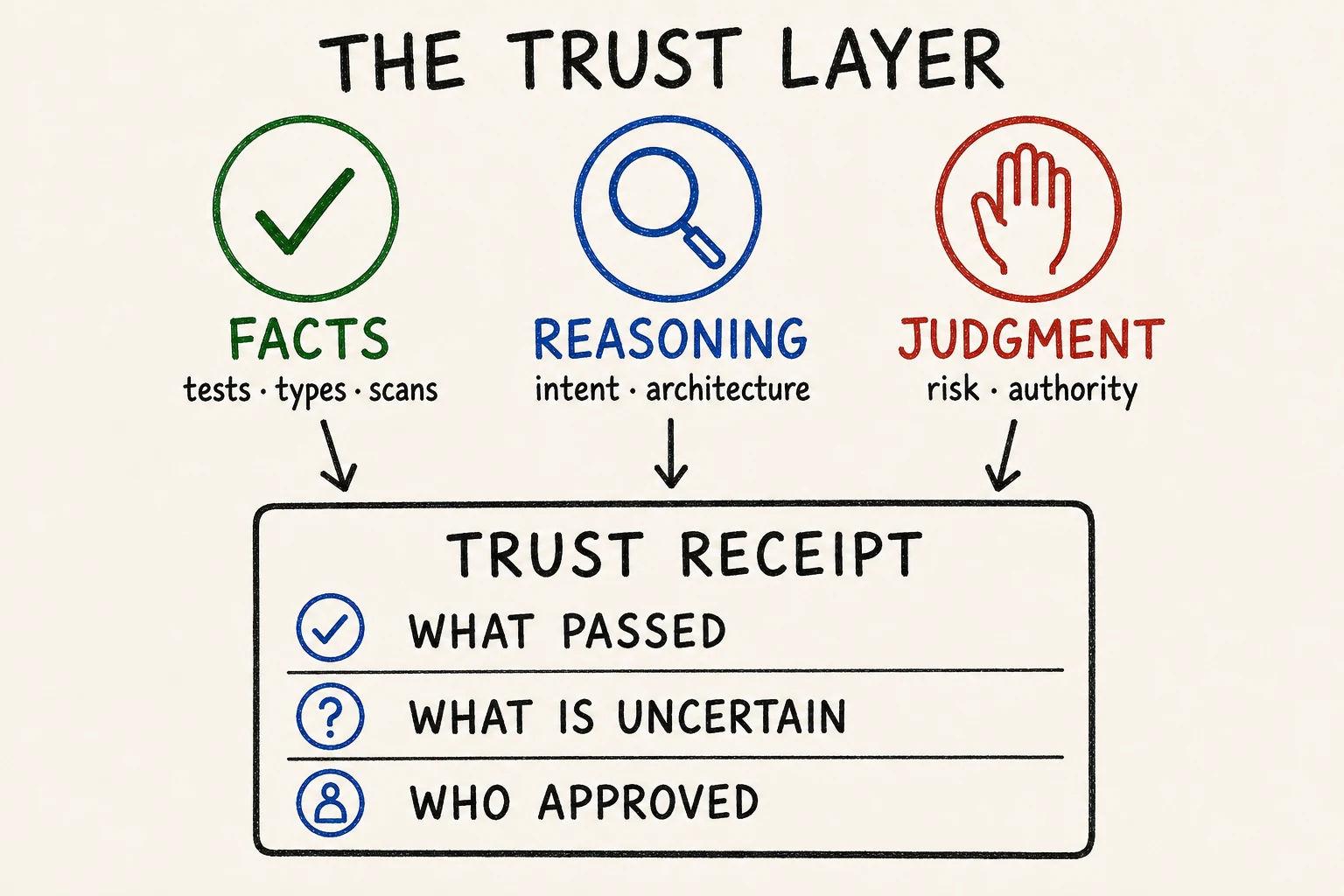
The trust receipt combines three kinds of evidence:
- Computational facts: the build passed, 214 tests ran, and the dependency scan found no known vulnerability. These results are deterministic.
- Inferential assessments: the change appears to match the specification or may violate an architectural boundary. These claims need confidence and supporting evidence.
- Human judgment: the requirement is correct, the tradeoff is acceptable, and the remaining risk is worth taking. Someone must own these decisions.
For this to work, intent must be readable by machines. That is the deeper contribution of AI-DLC and spec-driven development: they move intent out of chat history and human memory into versioned artifacts before implementation begins.
The specification can be short. It needs to capture the behavior, non-goals, edge cases, and invariants that matter—and connect them to tests or decisions.
Verification must also be independent. If the same agent generates the specification, implementation, and review from the same context, three green checkmarks may be one mistake agreeing with itself three times. A separately versioned specification, an independent verifier, and deterministic checks provide stronger evidence.
A refund that passes—and is still wrong
Imagine an agent changing a refund service. The calculation is numerically correct. The unit tests and type checker pass. The branch is green.
But the specification contains one additional rule: every refund must go through RefundPolicy, because that aggregate enforces audit logging and downstream accounting behavior.
The generated code bypasses it.
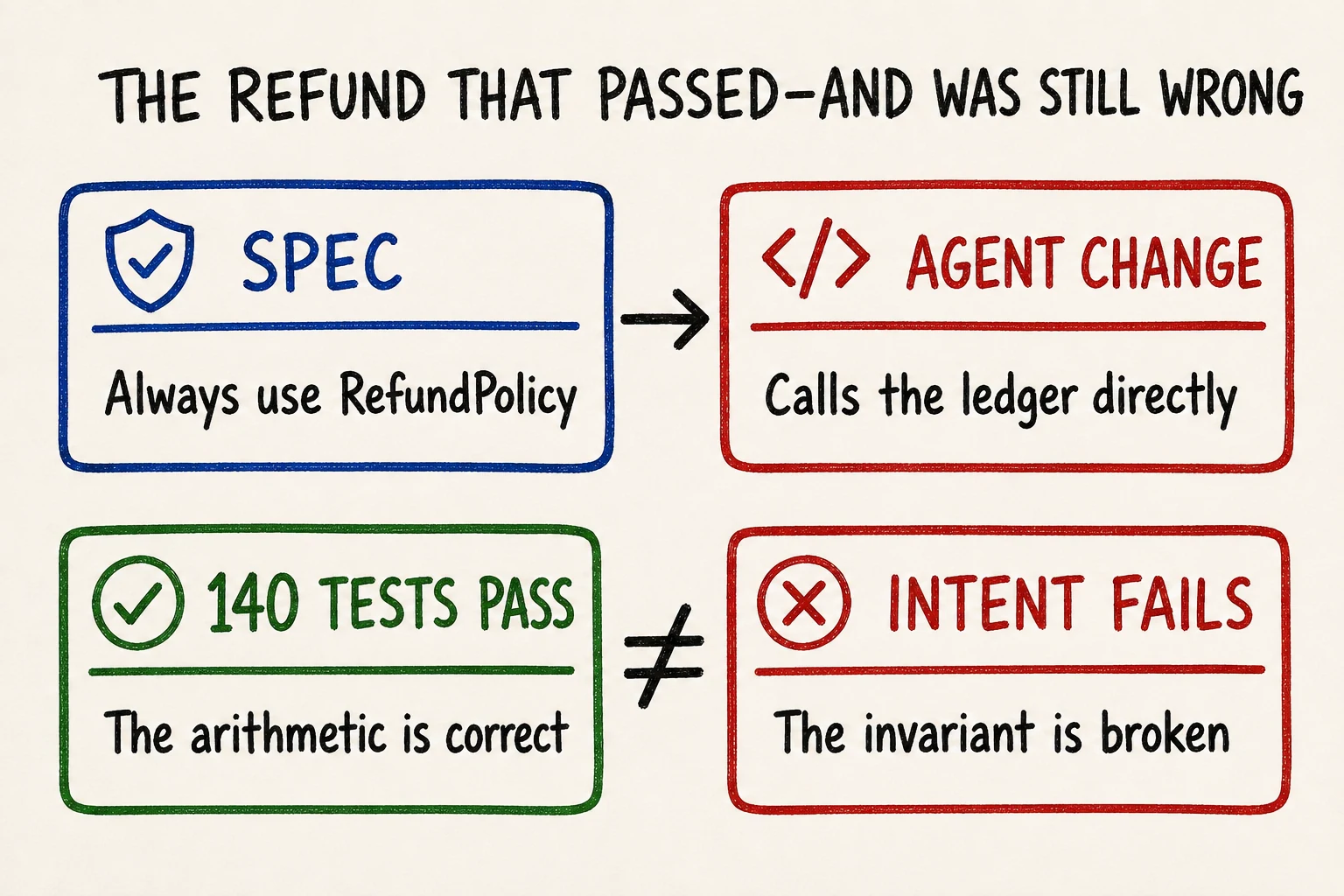
The receipt makes the conflict obvious:
- Intent: implement the approved refund calculation through
RefundPolicy. - Deterministic evidence: 140 relevant tests passed.
- Semantic finding: the implementation calls the ledger directly.
- Known gap: cross-region retry behavior was not verified.
- Recommendation: hold the change for a human decision.
The reviewer no longer reads 38 files and hopes to notice the important one. The pipeline names the conflict; the human resolves it.
Local checks are for speed. CI is for trust.
If the coding agent already ran the tests, why should CI run them again?
Because the two runs answer different questions.
The local loop asks, “Can the agent keep working?” It should be fast and optimized for correction.
The central pipeline asks, “Can the organization act on this result?” It runs against the integration state, with canonical policies and persistent artifacts. The commands may be identical. The meaning of the results is not.
In this model, CI becomes an evidence compiler: it reads the diff, approved intent, repository rules, and risk policy; runs the relevant checks; records gaps; and emits a receipt other systems can use.
That receipt should route the change by consequence, reversibility, and uncertainty—not reduce everything to one trust score.
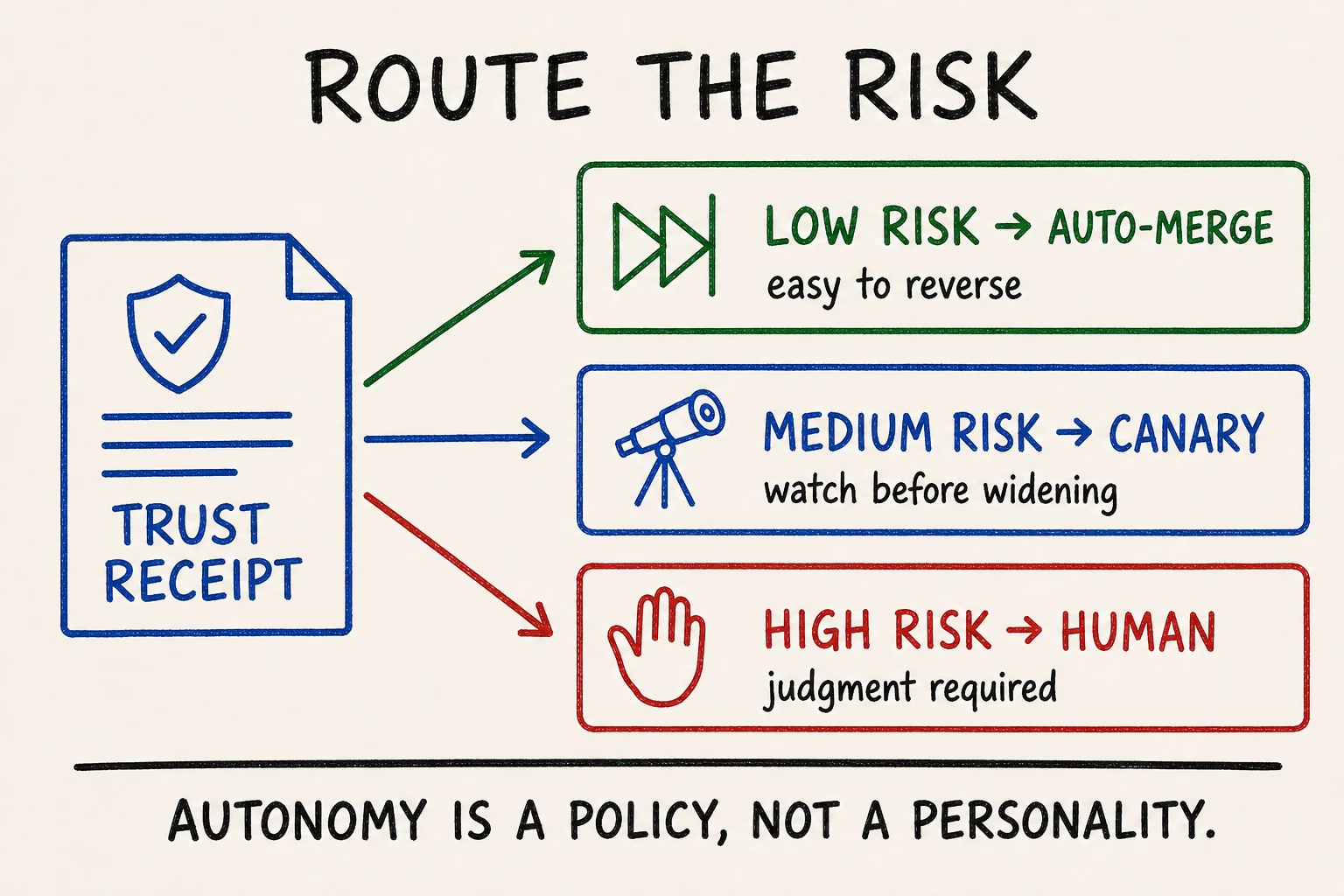
A low-risk documentation change can merge automatically. A reversible UI change can ship to a canary. A change to identity, payments, or data deletion can require a human even when every automated signal is green.
Autonomy is a policy for each class of change, and it must be earned. Track false approvals, false alarms, rollbacks, escaped defects, and human overrides. Widen autonomy when the evidence proves reliable; narrow it when the evidence drifts.
How to get there
Do not start by building a fleet of verification agents. Start with one narrow, measurable use case.
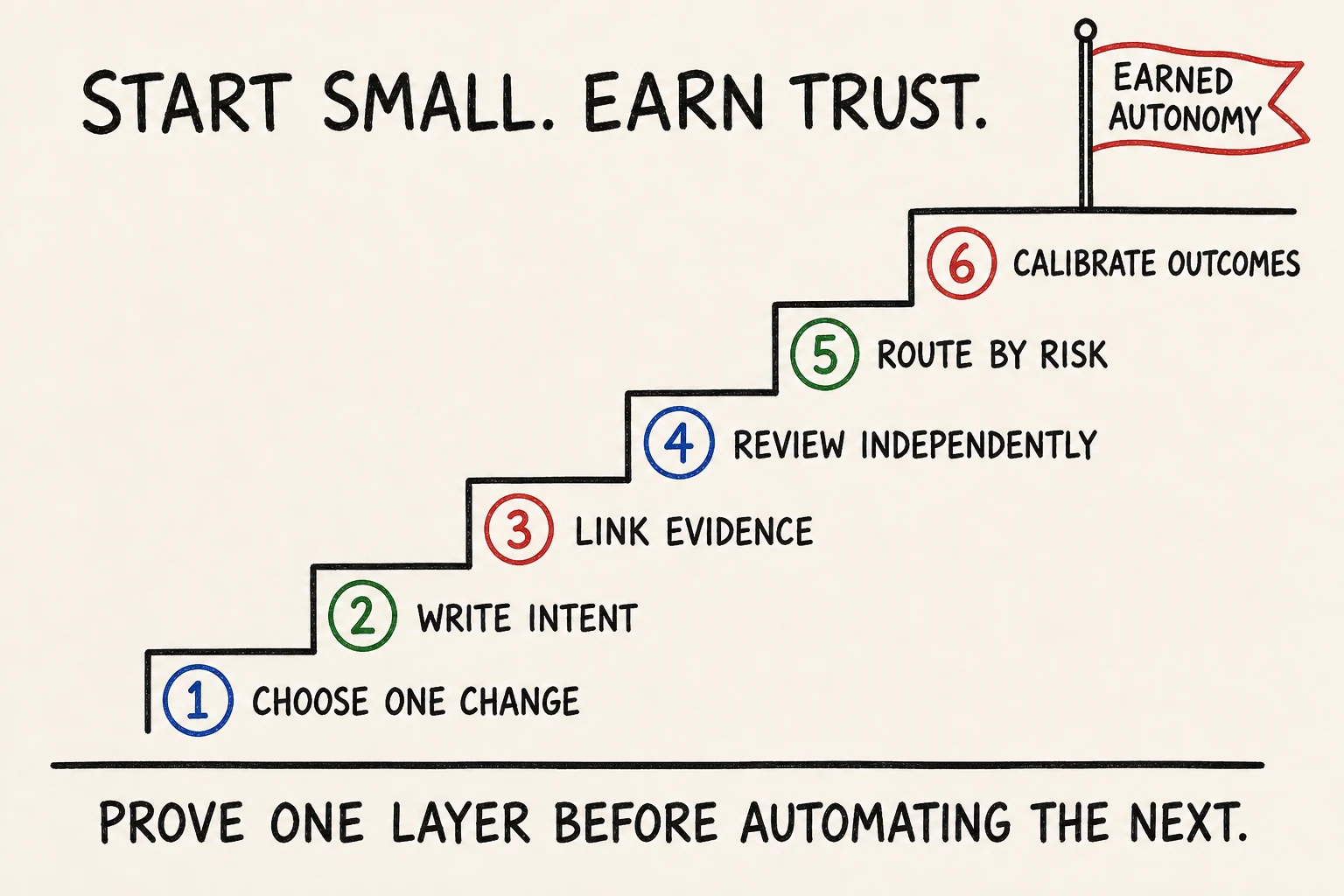
- Choose one bounded change type. Dependency updates, feature flags, or small UI changes are good candidates.
- Write intent before code. Record the requirement, acceptance criteria, non-goals, and critical invariants.
- Connect claims to evidence. Map each criterion to a test, structural rule, semantic check, or human decision.
- Add independent review. Give the verifier the approved specification and the diff—not the implementation agent’s reasoning.
- Emit a receipt and route by risk. Record what passed, what remains uncertain, and who must decide.
- Calibrate against outcomes. Use accepted findings, overrides, rollbacks, and escaped defects to adjust the policy.
That is enough to create the first useful AI-native delivery loop: intent shapes implementation, evidence evaluates the change, risk determines the route, and production outcomes improve the next decision.
Code is not the only output
The goal is not to automate every gate. It is to make every delivery decision explainable.
An AI-native SDLC needs a trust layer that keeps facts separate from probabilistic judgments, preserves the evidence behind each decision, and sends human attention to the changes that require human authority.
The code is one product of the pipeline. The receipt is another.
When every change can explain what it was meant to do, how it was verified, what remains unknown, and why it was allowed to proceed, AI speed becomes delivery speed instead of review debt.
That is the AI-native SDLC teams should build.